

What coatings can be applied to a piston rod for corrosion protection?
As a piston rod supplier, I understand the critical role that piston rods play in various industrial applications. A piston rod's functionality often relies on its ability to withstand harsh environments, including corrosion. Applying appropriate coatings is a proven strategy to enhance the piston rods' corrosion resistance and extend their service life. In this blog, I'll explore several types of coatings that can be used for piston rod corrosion protection.
1. Hard Chrome Plating
Hard chrome plating is one of the most commonly used coatings for piston rods. This process involves depositing a layer of chromium onto the piston rod surface through an electroplating method. The hard chrome layer can offer excellent corrosion resistance, as it forms a dense, passive film that acts as a barrier against corrosive agents.
The chrome layer also provides high hardness. A chrome - plated piston rod typically has a hardness ranging from 800 - 1200 HV, depending on the plating process and conditions. For instance, our Chrome Plated Steel Bar 800 - 1200 HV 10 Micron Chrome Thickness offers a well - controlled chrome thickness of 10 microns, which is sufficient to protect the underlying steel from corrosion in many working environments.
In applications where the piston rod is exposed to humidity, moisture, or mild chemical solutions, hard chrome plating can significantly reduce the risk of rust and pitting. However, it's important to note that hard chrome plating has some limitations. For example, the plating process involves the use of hexavalent chromium, which is a known carcinogen. Therefore, strict environmental regulations govern the disposal of waste from the plating process.
2. Nickel - Based Coatings
Nickel - based coatings are another option for piston rod corrosion protection. There are different types of nickel - based coatings, such as electroless nickel plating and electroplated nickel.

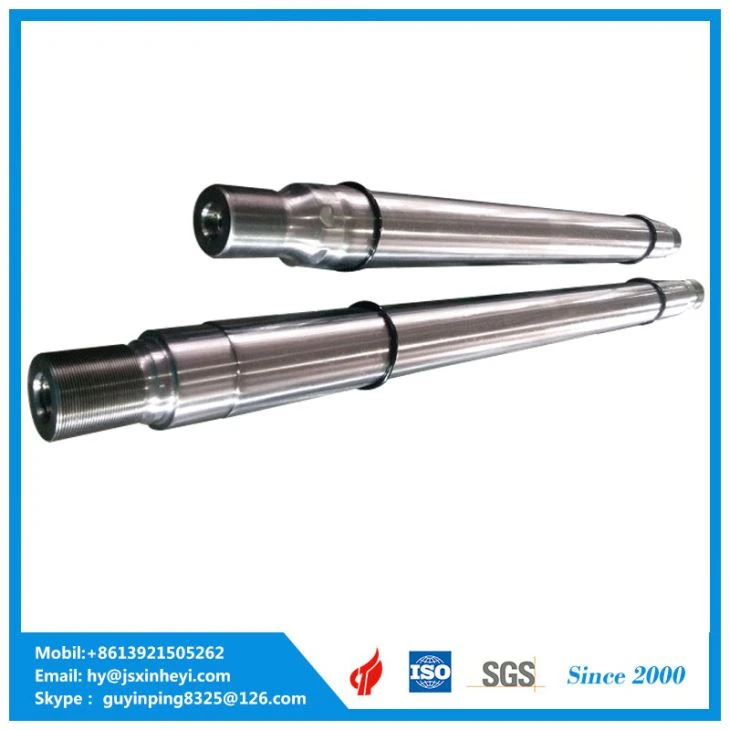
Electroless nickel plating is a chemical process that deposits a nickel - phosphorus alloy onto the piston rod surface without the use of an external electrical current. This coating has good corrosion resistance, especially in environments containing acids, alkalis, and salts. The nickel - phosphorus alloy forms a uniform layer that can protect the piston rod from both general and localized corrosion.
Electroplated nickel, on the other hand, uses an electrical current to deposit a layer of nickel onto the piston rod. This type of coating can be customized in terms of thickness and properties. It offers good adhesion to the substrate and can provide a hard and smooth surface, which is beneficial for reducing friction in piston rod applications.
Nickel - based coatings also have the advantage of being able to be alloyed with other elements, such as boron or tungsten, to further enhance their properties. For example, adding boron to a nickel - based coating can increase its hardness and wear resistance, which is beneficial in applications where the piston rod is subjected to both corrosion and mechanical wear.
3. Ceramic Coatings
Ceramic coatings are a relatively new but promising option for piston rod corrosion protection. These coatings are made from ceramic materials, such as aluminum oxide (Al₂O₃) or zirconium oxide (ZrO₂), and are applied to the piston rod surface through processes like thermal spraying or chemical vapor deposition.
Ceramic coatings offer excellent corrosion resistance, as they are chemically inert and can resist the attack of a wide range of corrosive substances. They also have high hardness and wear resistance, which can improve the durability of the piston rod in high - friction applications.
In addition, ceramic coatings can provide thermal insulation. In applications where the piston rod is exposed to high temperatures, such as in internal combustion engines, ceramic coatings can help reduce the heat transfer to the underlying steel, thereby extending the rod's service life.
However, the application of ceramic coatings requires specialized equipment and processes. The coating process can be relatively expensive, and the ceramic coating may be brittle, which can lead to cracking if the piston rod is subjected to high impact loads.
4. Powder - Coating
Powder - coating is a dry finishing process in which a fine powder is electrostatically applied to the piston rod surface and then cured under heat. The powder particles melt and form a continuous, protective film on the rod.
Powder - coatings offer good corrosion resistance and can be formulated to have different colors and textures. They are also environmentally friendly, as they do not contain solvents or volatile organic compounds (VOCs) that are commonly found in liquid coatings.
In terms of corrosion protection, powder - coatings can provide a barrier against moisture, oxygen, and other corrosive agents. They can be used in various industrial applications, including automotive, construction, and agricultural machinery. However, the adhesion of powder - coatings may be affected by surface preparation. Proper cleaning and pre - treatment of the piston rod surface are essential to ensure good adhesion and long - term corrosion protection.
5. Polymer - Based Coatings
Polymer - based coatings, such as epoxy, polyurethane, and polyethylene coatings, are widely used for piston rod corrosion protection. These coatings can be applied as liquids or in powder form.
Epoxy coatings are known for their excellent adhesion, chemical resistance, and mechanical properties. They can form a tough, durable film on the piston rod surface, protecting it from corrosion in both aqueous and chemical environments.
Polyurethane coatings offer good flexibility, abrasion resistance, and weatherability. They are often used in outdoor applications where the piston rod is exposed to sunlight, rain, and temperature changes.
Polyethylene coatings provide a high - density, non - reactive barrier that can protect the piston rod from corrosion and abrasion. They are particularly suitable for applications in the food and beverage industry, where the coating must be non - toxic and resistant to food - related chemicals.
These polymer - based coatings can be customized in terms of thickness, hardness, and other properties to meet the specific requirements of different applications.
Choosing the Right Coating
Selecting the appropriate coating for a piston rod depends on several factors. Firstly, the working environment of the piston rod is crucial. If the rod is used in a marine environment, it will need a coating that can withstand high salt concentrations. For applications in the chemical industry, a coating with high chemical resistance is required.
The mechanical requirements of the piston rod also play a role. If the rod is subjected to high - speed movement and friction, a coating with good wear resistance is necessary. Cost is another important consideration. Some coatings, such as ceramic coatings, can be more expensive to apply, while others, like powder - coatings, may offer a more cost - effective solution.
As a piston rod supplier, we offer a variety of piston rods with different coatings to meet the diverse needs of our customers. Our CK45 Hard Chrome Piston Rod Steel Bar is an example of a well - coated piston rod that offers both corrosion resistance and good mechanical properties. We also provide Induction Hardened Connecting Rod 40CrMnMo High Precison Grinding, which can be further enhanced with appropriate coatings for corrosion protection.
If you are in the market for piston rods with reliable corrosion protection coatings, we are here to help. We can provide technical support and advice on choosing the right coating for your specific application. Contact us to start a discussion about your piston rod requirements, and let's work together to find the best solution for your business.
References
- Davis, J. R. (Ed.). (2004). Handbook of corrosion engineering. ASM International.
- Uhlig, H. H., & Revie, R. W. (1985). Corrosion and corrosion control: an introduction to corrosion science and engineering. John Wiley & Sons.
- Schweitzer, P. A. (1999). Corrosion resistance tables. CRC Press.